






















Mitihoon – 2025 was a breakthrough year for payments in Thailand and across Asia Pacific. The convergence of new technologies like AI and Web3 has transformed how commerce, trade, and money move. With mobile-first consumers, rapid digital adoption, and expanding digital infrastructure, Thailand remains at the forefront of payment innovation real-time and mobile payments are reshaping how businesses and people pay and get paid.
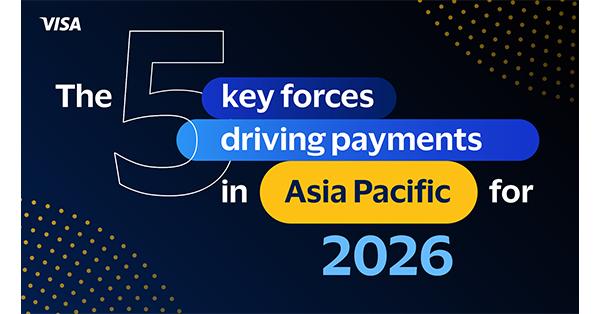
If 2025 was fast, 2026 will be even faster. Progressive regulation and widespread access to smartphones are driving profound changes in how Thais engage with money. Asia Pacific is the epicentre of payment innovation, and Thailand is leading in five key areas:
- Agentic commerce goes mainstream – even for businesses
AI is tipping commerce into a whole new era. Visa ushered in the age of eCommerce with safe, reliable, and seamless digital payments. The next wave of this evolution is AI-led or agentic commerce, where AI agents act on behalf of consumers to search, shop, and pay for their purchases.
This is far from science fiction. Generative AI platforms are creating online retail traffic at a breakneck pace in the United States, surging 4,700% year-on-year in July 2025[1] and given Asia Pacific’s digital and mobile-first landscape, this seismic shift will materialise in the region too.
It is not just consumers making the AI leap. Asia Pacific has over 200 million companies and is the world’s largest exporting region, with 70 of the top 80 trade corridors touching a market in the region. The “consumerisation” of B2B payments, driven by a new generation of business leaders seeking to replicate easy, frictionless, and secure consumer payments in their business will also accelerate demand for intelligent AI agents that can interpret business intent, orchestrate workflows, and cut time needed to complete payments.
In 2026, we expect more agentic experiences to surface in the market. The expanded Visa Intelligent Commerce suite of integrated APIs and programs includes the new Trusted Agent Protocol, a new low-code solution to help merchants recognise trusted agents, scaling trust at both sides of the transaction.
- Not fiat or crypto, but fiat and crypto
The debate between traditional currencies and digital assets is over. The future is about interoperability. Visa’s stablecoin initiatives including pilots with Nium and the rollout of stablecoin-based payouts on Visa Direct enable seamless money movement between fiat, and digital currencies.
Stablecoins are becoming increasingly integrated into the global financial ecosystem, surpassing US$250 billion, with Visa supporting over 130 stablecoin-linked card programmes in more than 40 countries and reaching a US$3.5 billion annual settlement run rate. Regulatory clarity is improving in Asia Pacific markets such as Singapore, Hong Kong, and Japan, and Thailand is moving forward as well. This is matched by accelerating expertise and consulting, such as Visa’s new Global Stablecoins Advisory Practice, to set the pace for more stablecoin integration into the region’s economies.
- Identify the heart of security, especially in the age of AI
In 2026, secure and trusted authentication will be a strategic differentiator. More industry-wide collaboration will emerge as governments, businesses, and payment networks come together to combat AI-driven identity fraud. Visa is leading the charge with layered security solutions, including:
- Accelerating tokenisation: Protects payment credentials by replacing card details with specific cryptographic keys, enabling consumers to provision their cards securely to mobile wallets and even AI agents they trust. Compared to PAN-based transactions, fraud rates are 34% lower.[2]
- Harnessing biometrics: Enables more secure transactions when physical cards are absent by verifying consumers’ unique biological signatures such as fingerprints and faces – reducing fraud rates by as much as 50% compared to one-time passwords.[3]
- Securing the ecosystem: Visa has invested US$13 billion in its technology and infrastructure over the past five years, creating new fraud prevention services such as the Visa Scam Disruption that protects all kinds of payments and commerce.
- Goodbye to online manual guest checkouts
As eCommerce matures in Asia Pacific, typing in card numbers and security codes are fast becoming a relic. Consumers want fast and reliable checkouts: Visa’s research found that six in 10 respondents in Asia Pacific faced issues with paying with cards at least once in the past year, due to forgotten card details and missed OTPs, leading to fractured consumer experiences and lost revenues for merchants.
Announced this year, Visa’s Click to Pay expansion across Asia Pacific speeds up the shift to faster, frictionless eCommerce checkouts. With added security in the form of tokenised credentials and biometric authentication with Visa Payment Passkey, and major enablers and issuers on board, Click to Pay is set to usher in a new era of eCommerce.
- A renewed focus on interoperable payments
Asia Pacific is often the epicentre of payment breakthroughs: digital wallets, QR payments, and real-time payment (RTP) networks are all part of the region’s socioeconomic fabric. Thailand is a leader in QR payments and digital wallets, with PromptPay and real-time payments embedded in everyday life. The intersection of cash, cards, wallets, and digital currency will define 2026. Interoperability is key, ensuring Thais can use, spend, and move money across platforms, currencies, and borders.
In 2026, expect more governments and businesses in Asia Pacific to connect the dots in a digital-first, mobile-centric, and increasingly AI-powered region. More solutions like Visa’s Scan to Pay will emerge to let people pay with digital wallets at their favourite merchants, while issuers and platforms modernise their infrastructure, such as migrating to cloud-native and API-first platforms with Visa and Pismo to deliver integrated digital-first experiences.
2026 will not be just another year. It will be the first page of a new era in payments. Want to know more about payments in 2026? Read our global predictions: visa.com
[1] Generative AI-Powered Shopping Rises with Traffic to U.S. Retail Sites
[2] Visa Risk Datamart, Global, FY24 Q1–Q4 Token Fraud Rate vs PAN Fraud Rate by PV. Merchant’s individual rates may vary
Note: India domestic and all Russia transactions are excluded
[3] Analysis based VisaNet data globally, from July-December 2023, comparing biometric authentication to step-up through OTP sent over text message.
ติดตามช่องทางมิติหุ้นเพื่อรับข่าวสารตลาดทุนได้ตามลิงค์ด้านล่าง
Web : https://www.mitihoon.com/
Facebook : https://www.facebook.com/mitihoon
Youtube : https://www.youtube.com/@mitihoonofficial7770
Tiktok : www.tiktok.com/@mitihoon