


























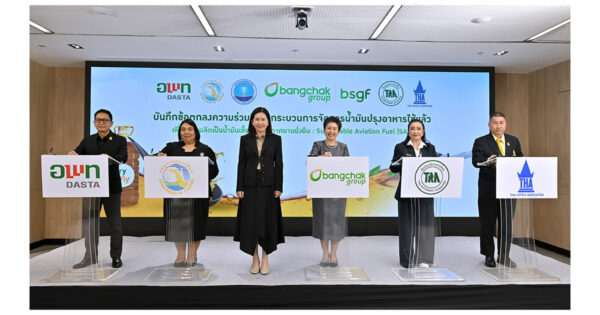
Mitihoon – Bangchak Corporation Public Company Limited, in collaboration with the Ministry of Tourism and Sports, through the Department of Tourism and the Designated Areas for Sustainable Tourism Administration (Public Organization) (DASTA), the Thai Hotels Association, and the Thai Restaurant Association, has signed a Memorandum of Understanding (MOU) on the management of used cooking oil for use as a feedstock in the production of Sustainable Aviation Fuel (SAF) under the Fry to Fly initiative.
The collaboration aims to promote the systematic collection of used cooking oil from hotels and restaurants, alongside campaigns against the repeated use of cooking oil, in order to safeguard consumer health, reduce environmental impacts, and maximize resource utilization in line with the principles of the circular economy.
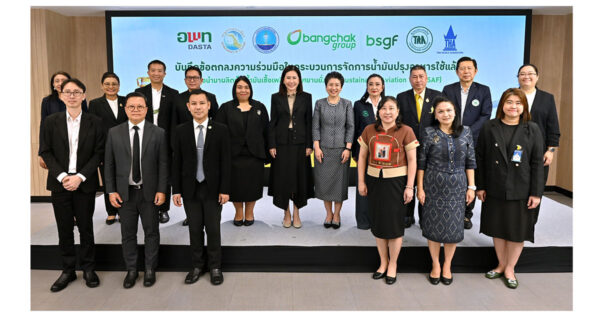
The signing ceremony was held on 5 October 2026 at Ministry of Tourism and Sports. Signatories included Mrs. Gloyta Nathalang, Senior Executive Vice President, Sustainability Management and Corporate Communications, Bangchak Corporation Public Company Limited, Miss Worateera Suvarnsorn, Deputy Director-General, Department of Tourism, Mr. Siripakorn Cheawsamoot, Director-General of Designated Areas for Sustainable Tourism Administration (Public Organization) (DASTA), Mr. Udom Srimahachota, Vice President and Chairman of the Environmental Committee, Thai Hotels Association and Ms. Thaniwan Kulmongkol, President, Thai Restaurant Association. The ceremony was honored by Ms. Natthriya Thaweevong, Permanent Secretary of the Ministry of Tourism and Sports, who served as the honorary witness, along with executives from relevant agencies and organizations.
Ms. Natthriya Thaweevong, Permanent Secretary of the Ministry of Tourism and Sports, said that the Ministry places strong emphasis on advancing sustainable tourism, recognizing that sustainability requires collaboration across all sectors and must be implemented throughout the entire tourism value chain—from transportation, accommodation, and food to resource and environmental management.
“Sustainable tourism is not merely about preserving tourist destinations. It means transforming the way the entire system operates. The collaboration under the Fry to Fly initiative is a good example of bringing materials generated within the tourism and hospitality sectors, particularly used cooking oil, back into the production system to create new value. By connecting hotels and restaurants with the aviation sector, this initiative creates collaboration that addresses environmental, economic, and social dimensions.”
This collaboration marks another important step in connecting “tourism–food–hospitality–energy–aviation” to ensure that the growth of Thailand’s tourism sector goes hand in hand with efficient resource utilization, reduced environmental impacts, and the development of a tourism ecosystem capable of sustainable long-term growth.
Mrs. Gloyta Nathalang said, “As the world moves toward a low-carbon society to achieve sustainability, the tourism and hospitality sectors can play an important role in driving this transition through various channels, with low-carbon energy being one of the key solutions. Sustainable aviation requires collaboration that extends beyond the airport. Hotels and restaurants therefore play an important role in collecting used cooking oil for SAF production through the Fry to Fly initiative. This collaboration connects the tourism and hospitality sectors with efforts to reduce greenhouse gas emissions from aviation, transforming used materials into valuable feedstock while promoting the non-reuse of cooking oil. It presents an opportunity for participating organizations and stakeholders to jointly safeguard both consumer health and the environment.”
Bangchak Group has more than two decades of experience in converting used cooking oil into biofuels, beginning with the production of biodiesel for road transportation and subsequently expanding into SAF production using the HEFA-SPK process in accordance with international standards. This represents a transition in the use of biofuels from road transportation to aviation. At the event, information on the Fry to Fly and Farm to Fly initiatives was also presented, showcasing approaches to converting used cooking oil and agricultural feedstocks into biofuels.
Mr. Siripakorn Cheawsamoot said: “DASTA is responsible for promoting and supporting development and environmental conservation for sustainable tourism. This collaboration marks an important step for DASTA in integrating sustainable tourism with the Circular Economy. It has three key objectives in support of sustainable tourism: 1) Health and safety: Establishing food safety standards for tourists by encouraging tourism communities and restaurant operators in designated areas to stop reusing cooking oil, which can pose health risks. 2) Environment and low-carbon tourism: Preventing the disposal of used cooking oil into water sources or soil, while reducing greenhouse gas emissions from the tourism industry. 3) Circular Economy: Creating additional income opportunities for local communities and entrepreneurs by enabling them to exchange or sell used cooking oil rather than disposing of it.”
ติดตามช่องทางมิติหุ้นเพื่อรับข่าวสารตลาดทุนได้ตามลิงค์ด้านล่าง
Web : https://www.mitihoon.com/
Facebook : https://www.facebook.com/mitihoon
Youtube : https://www.youtube.com/@mitihoonofficial7770
Tiktok : www.tiktok.com/@mitihoon