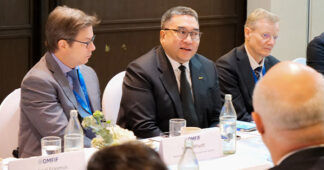



























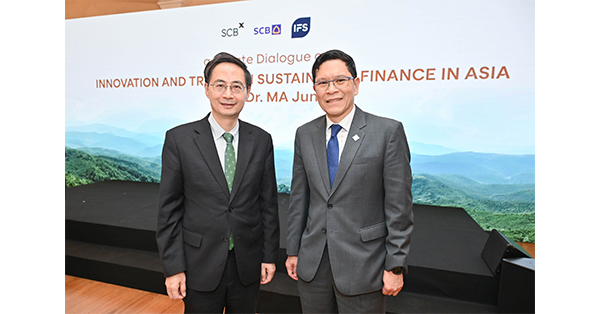
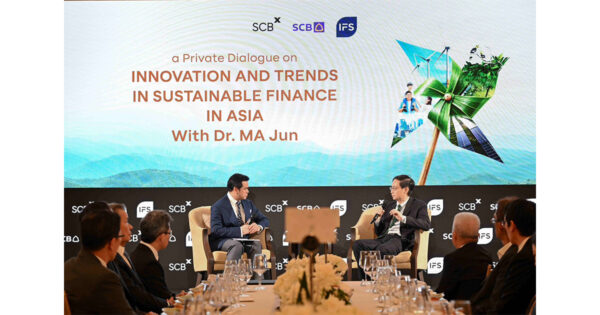
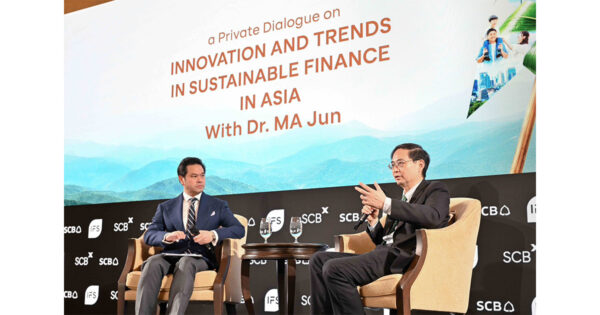
Mitihoon – SCBX Group led by SCB X Public Company Limited and Siam Commercial Bank Public Company Limited hosted “Innovation and Trends in Sustainable Finance in Asia,” an exclusive strategic dialogue with Dr. MA Jun, Founder and President of the Institute of Finance and Sustainability (IFS), at the historic SCB Talad Noi Branch. Held as a side event alongside the 2026 IMF–World Bank Group Annual Meetings in Bangkok, the event positioned Thailand as an important regional forum for advancing sustainable finance, bringing together leaders from the financial, business and policy sectors to explore how green finance can strengthen climate resilience, economic competitiveness and long-term sustainable growth.
Positioning Sustainability at the Heart of Financial Leadership
In his opening remarks, Dr. Veerathai Santiprabhob, Chairman of the Sustainability Committee of SCBX, framed the dialogue around three imperatives: stewardship, resilience and partnership. He stressed that climate change is no longer a distant environmental concern but an economic development challenge already reshaping risk, investment and competitiveness. For SCBX and SCB, sustainability is a core business strategy focused on creating win-win outcomes for customers, climate and society. SCB has mobilized nearly 300 billion baht in sustainable finance from 2023 to June 2026, making it the largest sustainable finance provider in Thailand, and aims to scale this to at least 500 billion baht by 2030, underscoring the Group’s commitment to supporting Thailand’s long-term resilience and sustainable transformation.
“Sustainability must be embedded in the way finance supports the real economy,” said Dr. Veerathai. “As climate risks become economic risks, financial institutions have a responsibility to help customers transform, adapt and build long-term resilience. For SCBX and SCB, green finance is not only about funding environmentally positive projects; it is about enabling the transition of businesses, communities and the broader economy toward a more sustainable future.”
Global Lessons for Scaling Green Finance
Dr. MA Jun, former Chief Economist of the Research Bureau of the People’s Bank of China and one of the world’s foremost architects of green finance, shared global lessons on how countries can move from policy ambition to market implementation. Drawing on his experience in drafting China’s green finance policy guidelines and helping build international consensus through the G20, Dr. MA said effective green finance requires more than aspiration. It relies on credible taxonomies, coordinated policy execution, transparent disclosure, innovative financial products and incentives that make green investment commercially compelling.
Whole-of-government coordination is essential. Dr. MA noted that green finance cannot be advanced by a central bank, regulator or financial institution alone. Effective implementation requires policymakers, environmental agencies, market regulators and industry bodies to align finance, technology, environmental measurement and industrial policy. China’s experience proved that high-level coordination helped turn green finance from a policy concept into market practice, while targeted measures such as incentives for electric vehicles and investment in charging infrastructure helped accelerate demand and overcome early market barriers.
Clear and interoperable standards lower the cost of capital. Dr. MA emphasized that taxonomies are fundamental to preventing greenwashing and giving banks, investors and businesses a common language for defining green activities. Rule-based taxonomies can reduce verification costs, strengthen market confidence and support the scaling of green lending and green bonds. Greater interoperability across jurisdictions can also facilitate cross-border capital flows. He cited common taxonomy work between China and the European Union, later expanded with Singapore, as an example of how shared standards can reduce double labelling, attract international investors and lower financing costs. For ASEAN, taxonomy interoperability will be a critical next step in deepening regional sustainable finance markets.
Capacity building is the true bottleneck. Beyond policy frameworks, Dr. MA underscored the importance of building capabilities across the entire financial value chain. Sustainable finance cannot be driven only from the boardroom; relationship managers, credit officers, product developers, risk teams and clients must understand how green finance works and how it creates economic value. He pointed to China Industrial Bank, which expanded green finance training from a specialist team to approximately 10,000 employees, as a benchmark for institutional transformation. He also highlighted the Capacity-building Alliance of Sustainable Investment (CASI), which has developed more than 100 training modules and trained over 10,000 professionals globally, as a platform that could support capability development across Thailand and the wider region.
Technology is key to closing the bankability gap. Dr. MA highlighted how innovations such as solar-to-hydrogen solutions can become commercially scalable when supported by the right capital, technology and project structuring. To address the shortage of bankable green pipelines in developing markets, he launched the Green Accelerator, a non-profit platform that combines philanthropic capital, affordable green technologies and financing partners to turn early-stage opportunities into commercially viable assets. For Thailand and Southeast Asia, this underscores the opportunity to use finance and technology to unlock green projects that strengthen resilience, productivity and sustainable growth.
Bringing SMEs into the Green Transition
Dr. MA also highlighted one of the most important unfinished agendas in green finance: extending access to small and medium-sized enterprises. While large-scale projects and major corporates have benefited from green lending, SMEs often remain outside the system despite being central to supply chains and the real economy. He pointed to green supply chain finance, knowledge transfer, guarantees and concessional financing as practical tools to help SMEs adopt solutions such as rooftop solar, energy efficiency and waste-to-energy technologies. For Thailand, bringing SMEs into the transition will be essential to building a more inclusive, competitive and resilient green economy.
From Dialogue to Action
In his closing remarks, Mr. Prasan Chuaphanich, Vice Chairman of the Board and Chairman of the Executive Committee of SCBX, brought the discussion back to the three priorities introduced at the start of the evening: stewardship, resilience and partnership. He said the dialogue had given each theme practical meaning: stewardship begins with clarity through credible standards and market rules; resilience depends on the capability to turn transition ambition into bankable projects; and partnership requires technology, capital and expertise to operate as one ecosystem.
Mr. Prasan reaffirmed SCBX Group’s readiness to collaborate with Dr. MA Jun, the Institute of Finance and Sustainability and Thailand’s wider network of clients, regulators, investors and institutions to translate insight into action. He noted that the historic SCB Talad Noi Branch, which once served the economy of an earlier generation, had become a meaningful venue for leaders to discuss how finance can help shape the economy of the next generation. The event concluded with a call for continued collaboration to build a Thailand that is more resilient, more competitive and more sustainable for generations to come.
“Tonight’s dialogue reinforces our belief that sustainable finance can become a powerful engine for Thailand’s next chapter of growth,” said Mr. Prasan. “By combining clear standards, stronger capabilities, innovation and partnership, we can move from ideas to implementation and turn green finance into real impact for businesses, society and future generations.”
ติดตามช่องทางมิติหุ้นเพื่อรับข่าวสารตลาดทุนได้ตามลิงค์ด้านล่าง
Web : https://www.mitihoon.com/
Facebook : https://www.facebook.com/mitihoon
Youtube : https://www.youtube.com/@mitihoonofficial7770
Tiktok : www.tiktok.com/@mitihoon