



























Mitihoon – KResearch views that the ‘America First’ policy has altered the direction of US trade policy and heightened uncertainty for the global economy through import tariff measures that have expanded from China to many other countries, leading to the imposition of import tariffs worldwide across multiple industries. As a result, the global economy and international trade are facing elevated uncertainty. Looking ahead into 2026, several key developments are expected to shape the direction of global trade, including a meeting between Chinese and US leaders, the review of the revised United States–Mexico–Canada Agreement (USMCA), and court rulings on whether the use of the International Emergency Economic Powers Act (IEEPA) to implement tariff policies will be deemed invalid. The US continues to rely on import tariff policies to protect its domestic industries. For Thailand, it is crucial to accelerate the conclusion of free trade agreements (FTAs) with the European Union (EU) and the US to avoid losing competitiveness, particularly in the gems and jewelry industry, which competes directly with India.
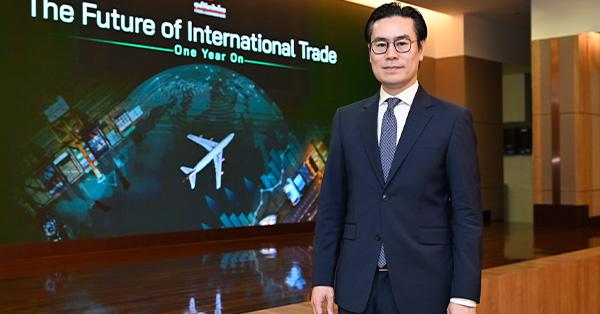
Mr. Burin Adulwattana, Managing Director and Chief Economist of KASIKORN RESEARCH CENTER (KResearch), said the announcement of the ‘America First’ trade policy by President Donald Trump marked a shift in US policy direction. This change has not only affected the structure of global trade, but has also accelerated the need for other countries to significantly adjust their strategies in terms of geopolitics and supply chains. Measures that initially targeted China have expanded into the imposition of import tariffs on many countries worldwide and across multiple industries, resulting in heightened uncertainty for the global economy and international trade.
Over the past year, President Trump has invoked national security and political considerations to impose import tariffs, including reciprocal tariffs and product-specific tariffs under Section 232. Additionally, President Trump has pursued a geopolitical policy aligned with the Monroe Doctrine, which views North and South America as the US sphere of influence. This is reflected in the establishment of reciprocal tariffs for most Latin American countries at 10 percent, while Brazil has been subject to a 50-percent tariff for political reasons.
However, the ‘America First’ policy has not had as severe an impact on global trade, or the US and world economy, as initially expected. This is partly because the implementation of this measure was delayed (starting in August 2025), and most countries did not raise import tariffs in retaliation against the US government.
Regarding the impact of US trade policy, although the value of exports from China to the US declined by around 20 percent in 2025, China’s overall shipments continued to expand strongly, reaching a record trade surplus of USD 1.2 trillion. China has redirected exports to other regions such as ASEAN, the European Union (EU), and Africa, which in part still reflects transshipment practices used to avoid tariffs.
China has retaliated against US tariff measures, leveraging its significant advantage in rare earths and critical minerals. China’s near-monopoly over these global supply chains is vital to US strategic security and economic stability. Beyond reciprocal tariffs, the US has also imposed product-specific tariffs under Section 232 on items such as steel, aluminum, automobiles and parts, and semiconductors. In the future, tariffs on pharmaceuticals and medical supplies are also likely, aiming to encourage reshoring of production and increase employment in the manufacturing sector. As a result, leading companies across industries including semiconductors, automotive, and steel have begun announcing plans to expand investment in the US.
Nevertheless, manufacturing employment overall continued to contract in 2025, with growth seen only in certain sectors such as metal processing (particularly steel).
In 2026, key events for the future direction of global trade include:
- The April meeting between President Xi Jinping and Donald Trump
- The US Supreme Court’s ruling which could invalidate the use of the International Emergency Economic Powers Act (IEEPA) to implement tariff policies
- The July review of the USMCA Agreement
- The US midterm elections in November
- The present suspension of reciprocal tariffs between China and the US, which is scheduled to end in November
The US is building walls, while other countries are building bridges. While the US is utilizing import tariffs to protect domestic industries, other nations are accelerating their own trade agreements. A prime example is India, which successfully finalized the India-EU Free Trade Agreement (FTA) within just a few months after nearly 20 years of negotiations. Furthermore, India’s ability to reach an accord with the US has allowed it to benefit significantly from the ‘America First’ policy.
For Thailand, the key issue to monitor is the impact on industries that compete directly with India in the US and EU markets—most notably the gem and jewelry sector. Thai exports are now at a competitive disadvantage compared to India as we lack an FTA with the EU. Going forward, the Thai government needs to expedite efforts to secure trade agreements with the EU and the US
ติดตามช่องทางมิติหุ้นเพื่อรับข่าวสารตลาดทุนได้ตามลิงค์ด้านล่าง
Web : https://www.mitihoon.com/
Facebook : https://www.facebook.com/mitihoon
Youtube : https://www.youtube.com/@mitihoonofficial7770
Tiktok : www.tiktok.com/@mitihoon