


























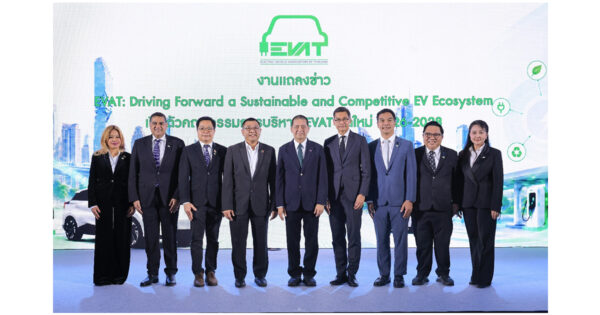
Mitihoon – The Electric Vehicle Association of Thailand (EVAT), led by Mr. Suroj Sangsnit, President of EVAT, together with the Association’s Vice Presidents, Secretary General, and Executive Committee members, officially introduced the strategic direction of its newly appointed Executive Committee for the 2026–2028 term under the vision:
“EVAT 2026–2028: Driving Forward a Sustainable and Competitive EV Ecosystem.”
Building upon the Association’s previous achievements, the new executive team aims to further strengthen Thailand’s electric vehicle (EV) and xEV ecosystem through systematic, competitive, and sustainable development. The vision was presented during the Electric Vehicle Innovation Exhibition 2026, held at the Queen Sirikit National Convention Center (QSNCC).
As a non-profit organization, EVAT plays a pivotal role in supporting the development of Thailand’s electric vehicle and xEV industries in alignment with the government’s policy to reduce emissions from the transportation sector while creating long-term benefits for the country’s industry, economy, and society.
Throughout the 2024–2026 term, EVAT has established itself as a central platform connecting collaboration among government agencies, private enterprises, industry operators, academic institutions, and consumers. The Association has actively contributed to policy recommendations, represented industry perspectives, supported business development, and promoted the sustainable growth of Thailand’s EV and xEV industries in line with the nation’s economic sustainability goals.
Mr. Suroj Sangsnit, President of EVAT, stated:
“For the 2026–2028 term, EVAT will continue building upon the strong foundation established over the past years by placing greater emphasis on developing a comprehensive EV ecosystem. This includes vehicle manufacturing, auto parts and supporting industries, battery technologies, charging infrastructure, safety standards, workforce development, and public awareness to enhance consumer understanding and confidence in electric mobility.
Our mission will be driven through six Vice Presidential divisions, each responsible for advancing different yet interconnected aspects of Thailand’s EV ecosystem—from knowledge development, technology, vehicle manufacturing, component production, infrastructure, standards and safety, workforce development, market adoption, to strengthening consumer confidence.
Our ultimate objective is to foster a high-quality, internationally competitive, and safe EV and xEV industry capable of generating sustainable economic value while laying a strong foundation for Thailand to become the electric vehicle hub of ASEAN.”
Strengthening Knowledge, Standards, and Human Capital
Asst. Prof. Dr. Uthane Supatti, Vice President for Academic, emphasized that the future development of Thailand’s EV industry requires strong knowledge, internationally recognized standards, and a highly skilled workforce, supported by policies that keep pace with rapidly evolving technologies and global industry trends.
“The Academic Affairs Division will serve as the Association’s knowledge and research hub, supporting standards development, workforce training, research-industry collaboration, and evidence-based policy recommendations that enhance Thailand’s competitiveness.
EVAT firmly believes that strengthening Thailand’s EV industry must be driven by knowledge, quality standards, and competent professionals to ensure sustainable growth in the future mobility industry.”
Advancing Thailand as a World-Class EV Manufacturing Base
Mr. Siamnat Panassorn, Vice President for EV Manufacturing Promotion, stated that the restructuring of EVAT reflects the Thai EV industry’s transition into a new phase of development.
“A strong EV manufacturing base should not be measured solely by the number of factories or production capacity. More importantly, it must focus on raising manufacturing quality to international standards.
EVAT will work closely with manufacturers to maximize the utilization of Thailand’s testing infrastructure and vehicle testing centers, enabling EVs manufactured in Thailand to obtain internationally recognized certifications, reduce certification costs, and improve global competitiveness.”
Three Strategic Priorities
EVAT also outlined three proactive strategic initiatives for the new term:
- Serving as an “Industry Ambassador” to Strengthen the Demand-Side Ecosystem
Building upon the successful collaboration among ten manufacturing-related associations representing the supply side—which recently issued a joint declaration supporting Thailand’s automotive industry—EVAT will now expand its role by connecting stakeholders on the demand side, creating stronger market-driven collaboration throughout the EV ecosystem.
- Supporting Government EV Fleet Transition
EVAT will work closely with key government agencies, particularly the Bureau of the Budget, the Thailand Board of Investment (BOI), and the National EV Policy Board, to accelerate the adoption of electric vehicles across government fleets through concrete policy implementation.
- Expanding EV Promotion Across All Mobility Segments
Thailand’s EV development should extend beyond passenger cars. EVAT will promote broader adoption of electric mobility, including electric motorcycles, which represent one of Thailand’s most widely used vehicle categories and possess significant domestic manufacturing potential.
The Association will collaborate with the Department of Land Transport and relevant regulatory agencies to strengthen vehicle standards, battery systems, and safety requirements that support practical use across all transportation sectors.
Mr. Siamnat concluded:
“When Thailand has internationally accredited manufacturing facilities, fully operational testing centers, government agencies leading EV adoption, reliable vehicle inspection standards for the used EV market, insurance companies capable of accurately assessing risks, and financial institutions confident in providing financing, we will achieve a truly complete demand-side ecosystem. This, in turn, will reinforce confidence in domestic manufacturing. That is the ultimate goal of our Manufacturing Promotion Division—to ensure Thailand’s EV industry continues to grow with strength and sustainability.”
Strengthening Local Supply Chains and Supporting Industries
Mr. Sutheep Ratnabhas, Vice President for Auto Parts and Supporting Industries Promotion, stated that the transition toward electric vehicles represents not merely a change in products, but a transformation of the entire automotive supply chain.
Thailand must accelerate the enhancement of its auto parts manufacturers and supporting industries to remain globally competitive throughout the EV transition.
During the 2026–2028 term, the division will focus on four strategic priorities:
- Enhancing the competitiveness of Thai auto parts manufacturers;
- Promoting the use of domestically produced components and local content;
- Strengthening collaboration among vehicle manufacturers, component suppliers, government agencies, academic institutions, and technology partners; and
- Supporting the development of related industries to build a stronger and more sustainable EV ecosystem.
Mr. Sutheep, further noted that Thailand is home to more than 2,000 automotive parts manufacturers, which have long served as the backbone of the country’s automotive industry.
“The transition to electric vehicles should be viewed as an opportunity to build upon the strengths of Thai manufacturers rather than requiring them to start over.
EVAT is committed to serving as a central platform that connects all stakeholders, enabling Thai businesses to integrate into the global EV supply chain while strengthening Thailand’s long-term competitiveness.
Our goal is to promote Thailand’s growth as both a major EV market and manufacturing hub, supported by a resilient supply chain that creates greater economic value and positions Thailand as a sustainable electric vehicle manufacturing center for ASEAN.”
Strengthening EV Infrastructure for Sustainable Growth
Mr. Assadayoot Ruthirago, Vice President for Infrastructure Development Promotion, stated: “The growth of Thailand’s EV industry depends not only on the number of electric vehicles or charging stations, but also on having a robust, standardized infrastructure capable of supporting long-term real-world usage. EVAT has identified four strategic priorities:
- Enhancing Standards and Safety
Particular emphasis will be placed on charging installations in residential properties, commercial buildings, and public areas. EVAT will also develop common charging standards for electric motorcycles and light electric vehicles to ensure safe and harmonized market growth.
- Expanding Power Grid Capacity and Charging Accessibility
The Association will advocate for a fast-track process for connecting public charging stations to the national electricity grid, enabling charging infrastructure to be deployed more efficiently.
- Developing National Digital Platforms and Data Infrastructure
EVAT supports the establishment of a National EV Roaming Hub, allowing EV users to access charging services more conveniently through a unified platform while reducing the need for multiple mobile applications. The initiative will also enable charging service providers to interconnect under common technical standards.
In addition, EVAT recognizes the importance of preparing for the implementation of Battery Passports and standardized battery data systems, which will become critical factors for exports, battery lifecycle management, and Thailand’s long-term industrial competitiveness.
- Improving Regulatory Clarity and Electricity Pricing
Clearer and more stable electricity tariff policies for public charging stations are essential to provide confidence for investors and encourage long-term expansion of Thailand’s charging network.
Mr. Assadayoot concluded:
“EV infrastructure is far more than charging stations. It forms the foundation of the entire electric mobility ecosystem—from EV users, charging station operators, electricity providers, vehicle manufacturers, and property developers to government agencies.”
Promoting EV Adoption Through Knowledge, Communication, and Regional Collaboration
Ms. Tamonwan Cholpratin, Vice President for EV Adoption Promotion and Public Relations, explained that the division’s mission extends far beyond communicating the Association’s activities.
“Our role is to connect knowledge, technology, and every sector of society so that electric mobility becomes accessible, practical, and beneficial to Thailand in the long term.”
Over the past several years, EVAT has continuously developed key initiatives to support Thailand’s EV ecosystem. The Association has published the EVAT Directory in both Thai and English, serving as a comprehensive information hub for Thailand’s electric vehicle industry.
EVAT has also partnered with the Tourism Authority of Thailand (TAT) to organize the Eco Exploration program, promoting sustainable tourism through electric vehicle travel. More than 200 electric vehicles participated in last year’s event, demonstrating both the readiness of Thailand’s charging infrastructure and growing public confidence in EV adoption.
During the new term, EVAT will launch the ASEAN EV Registration Intelligence initiative, a regional database designed to collect, analyze, and publish new electric vehicle registration data across ASEAN member states.
The database will provide comprehensive market intelligence, including vehicle registrations, market share, popular brands and models, and industry growth trends. It is intended to support policymakers, investors, industry stakeholders, researchers, and media organizations in making informed decisions.
EVAT aims to evolve from being Thailand’s leading EV information center into ASEAN’s premier hub for electric vehicle knowledge and market intelligence.
Over the next two years, the EV Adoption Promotion and Public Relations Division will focus on four strategic priorities:
- Expanding public knowledge by providing accurate, accessible, and up-to-date information about electric vehicles.
- Promoting safe, proper, and cost-effective EV usage to strengthen consumer confidence.
- Positioning EVAT as a trusted source of EV information and communication at both national and ASEAN levels.
- Building collaborative networks among government agencies, private companies, academic institutions, media organizations, the public, and international partners to jointly drive sustainable EV development.
Ms. Tamonwan added:
“Effective communication is not simply about sharing information. It is about building understanding, fostering trust, and inspiring people to become part of this important transition.
Our division is fully committed to making EVAT an organization trusted by the public, respected by the industry, and recognized internationally as the regional center of excellence for electric vehicle knowledge.
We firmly believe that the future of electric mobility begins not only with technology, but also with accurate information, strong collaboration, and public confidence.”
Secretariat to Strengthen Organizational Efficiency and Strategic Execution
Assoc. Prof. Dr. Sutapat Kwankaomen, Secretary General of EVAT, stated that the Association has now been operating for more than 10 years, during which its membership has expanded significantly across all categories, including corporate members, individual members, students, and associate members. EVAT has also established extensive collaborations with organizations both domestically and internationally.
“The Association has continued progressing toward becoming an internationally recognized organization under the leadership of three successive Presidents. With Mr. Suroj Sangsnit now serving his second term as President, we have an excellent opportunity to continue implementing our long-term strategies with greater continuity.”
The Secretariat will focus on improving organizational efficiency through five key functions:
- Serving as the Association’s central coordinator for internal and external operations.
- Integrating collaboration among all divisions and partner organizations.
- Supporting the implementation of EVAT’s strategic framework, including the Association’s Strategic Pillars, KPIs, Roadmap, Budget, and Annual Action Plans.
- Ensuring continuity, systematic implementation, and effective execution of the Association’s mission and strategic objectives.
- Encouraging active participation among EVAT members and partner organizations while strengthening domestic and international collaboration networks.
“All of these efforts are aimed at driving Thailand toward a truly sustainable electric vehicle ecosystem.”
The Secretariat will serve as the Association’s operational backbone, coordinating cross-functional activities and ensuring that EVAT’s initiatives are implemented efficiently, systematically, and effectively.
EVAT reaffirmed that the development of Thailand’s EV and xEV industries is not the responsibility of any single organization, but rather a shared mission requiring close collaboration among government agencies, the private sector, academic institutions, industry stakeholders, and the public.
Only through collective efforts can Thailand successfully reduce emissions from the transportation sector while achieving sustainable economic growth.
ติดตามช่องทางมิติหุ้นเพื่อรับข่าวสารตลาดทุนได้ตามลิงค์ด้านล่าง
Web : https://www.mitihoon.com/
Facebook : https://www.facebook.com/mitihoon
Youtube : https://www.youtube.com/@mitihoonofficial7770
Tiktok : www.tiktok.com/@mitihoon